Philippines Mayon Volcano: Church Team Visits Evacuation Center as 1,116 Families Remain Displaced
- Jan 23
- 4 min read
Messages from Mark Sherman, Tabaco City, Albay Province, Philippines
Everyone's been watching the Philippines' Mayon Volcano in awe. The lava. The power. That perfect conical shape rising above the Albay Gulf. I get it... it's stunning. But last week, I saw a different side of this story.

What You Don't See on the News
While the world watches lava flows descend the flank of the volcano and pyroclastic flows shoot from the summit crater, there are families in evacuation centers just a few miles away. They're not watching the show. They're waiting, wondering when they can go home.
The Philippines' Mayon Volcano, this active volcano that's been part of the landscape here in Albay Province for generations, reached Alert Level 3 on January 6. That means the volcanic activity could turn into violent eruptions within days or weeks. The upper slopes are unstable. The summit crater is actively growing a lava dome that keeps collapsing, sending rockfalls and pyroclastic flows down the southern side.
Over 4,000 people have been evacuated from the six-kilometer danger zone. That's 1,116 families who grabbed what they could and left everything else behind.
This volcano in the Philippines has erupted violently 54 times since 1616. The 1814 eruption occurred and killed 1,200 people, burying an entire town. You can still see the old church steeple sticking out of the ground. So yes... when the Philippines' Mayon Volcano shows signs of a major eruption, you get people out.
But that doesn't make it easy for the families who had to leave.
82 People in One Room
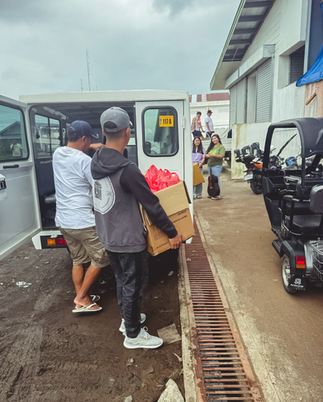
Today, a group of us from church went to one of the evacuation centers here in Tabaco City. We brought some food and just wanted to show up.

What we found: 82 people. 23 families. 13 kids under 5. Four moms nursing babies.
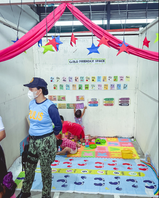
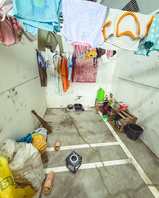
They're living in temporary stalls, basically partitioned spaces in a large room, with a handful of showers and toilets for everyone.
And yet, life goes on.
One woman was sitting in the corner weaving baskets to try and earn some extra money. Kids were playing in a tiny space someone set up with a few toys. Moms were cooking rice over small burners. Families were washing clothes by hand and hanging them to dry.





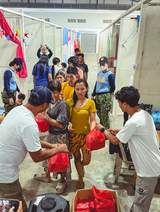
They were just... enduring. Adapting. Holding onto hope.
What Showing Up Looks Like
Two verses kept running through my head:
"Carry each other's burdens, and in this way you will fulfill the law of Christ." — Galatians 6:2
"Don't forget to do good and to share with those in need. These are the sacrifices that please God." — Hebrews 13:16
This is what Jesus would do. This is what Jesus did, He showed up. He sat with people. He fed them. He saw them.
And that's what the local church here is doing. Not because it's dramatic or newsworthy. Just because it's right.
We didn't do anything huge. Brought some meals. Sat with families. Listened. Prayed. Encouraged.
But you know what? Sometimes that's everything.




Why We Partner with Local Churches
This is exactly why Mosaic International exists, to walk alongside local churches who are already doing this work.
Pastor Edwin and Jo, our partners here in the Philippines, didn't wait for someone from the outside to tell them what to do. They live here. They know these families. When the eruption of Mayon Volcano forced people from their homes, the church mobilized immediately.
That's what local churches do. They don't just show up when disaster strikes. They're there before, during, and after. They know people's names. They understand the culture. They can respond with both urgency and genuine relationship.
The Philippines sits on the Pacific "Ring of Fire." Volcanic activity isn't rare here. Typhoons hit every year. Earthquakes shake the ground. For communities living near active volcanoes like the Philippines' Mayon Volcano, crisis isn't an "if" it's a "when."
And local churches are the ones who stick around for the long haul.
Our role at Mosaic isn't to swoop in with answers. It's to support the churches who are already loving their neighbors well, providing resources so they can keep showing the love of Jesus in tangible, practical ways.

The Wait Continues
As we are writing this, the Philippines' Mayon Volcano is still rumbling. The summit crater continues generating pyroclastic flows. Lava keeps building at the top. Scientists are recording hundreds of rockfalls. The volcano's flanks are swollen, a sign that magma is still moving underneath.
For the 1,116 families in evacuation centers across Albay Province, that means more waiting.
If Mayon settles and the alert level drops, they can go home. Until then, they wait.
But they're not waiting alone. The church is with them.
You Can Be Part of This
You don't have to live in Albay Province to make a difference.
When you partner with Mosaic International, you're empowering local churches around the world to be the hands and feet of Jesus, whether that's responding to the eruption of Mayon Volcano, providing clean water in Tanzania, supporting orphans in Rwanda, or walking alongside communities in South Asia.
It's not glamorous work. It's just faithful presence. Meals. Encouragement. Showing up.
But that's how Jesus changed the world. One person at a time. One meal at a time. One moment of presence at a time.
Blessed to be here.
Grateful we could encourage a few families today.
Praying the Philippines' Mayon Volcano settles soon and these families can go home safely.


Comments